
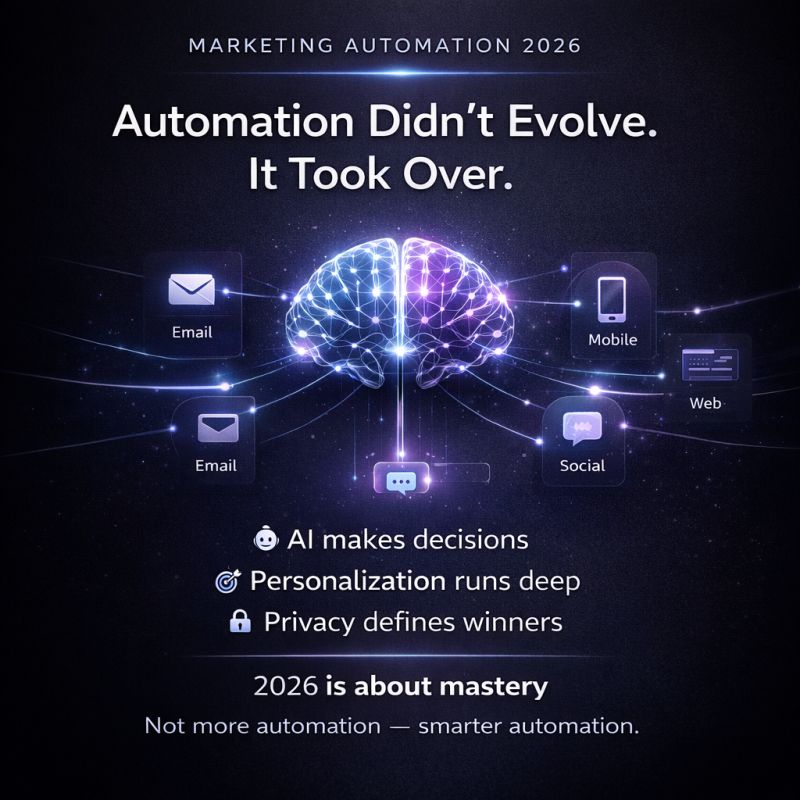
Marketing automation has crossed a structural threshold. What began as rule-based workflows and scheduled campaigns has matured into an intelligent system layer that actively makes decisions, reallocates budgets, and orchestrates customer journeys in real time. The shift is not incremental; it is architectural.
Here is a grounded look at what defines marketing automation in 2026 and what it practically means for businesses.
AI Is No Longer Assistive, It Is Autonomous
For years, AI supported marketers with recommendations. In 2026, it operates as a decision engine.
Modern platforms such as Klaviyo and HubSpot are increasingly embedding AI agents that plan multi-channel campaigns, allocate budgets dynamically, optimize creatives based on performance signals, and adjust targeting in real time.
According to HubSpot’s State of Marketing Report 2025, 92% of marketers report that AI has already impacted their roles, and a growing segment is moving toward fully automated campaign management via AI agents.
The implication is clear. The marketer’s role is shifting from execution to supervision, strategy, and constraint-setting. You are no longer running campaigns; you are governing systems.
Hyper-Personalization Has Become Infrastructure
Personalization is no longer a tactic. It is an always-on system capability.
Automation tools now synthesize behavioral data such as clicks, time on site, and purchase history, contextual signals like device, time, and location, and intent data from search behavior and engagement patterns. This enables brands to deliver individualized experiences across thousands or millions of users simultaneously.
In practice, product recommendations update in real time, email content dynamically changes per user, and landing pages adapt based on visitor intent.
Some verticals, particularly D2C and beauty ecommerce, have reported up to 94 percent increases in sales when deploying deep personalization strategies.
The implication is straightforward. Generic funnels are structurally inefficient. If your automation is not segmenting at a micro level, you are leaving conversion on the table.
Predictive Analytics Has Replaced Reporting
Traditional dashboards answered what happened. AI-driven systems now answer what will happen and what should be done next.
Platforms like Birdeye are enabling churn prediction before disengagement occurs, early detection of negative sentiment spikes, and forecasting campaign outcomes before full budget deployment.
Instead of reacting to lagging indicators, marketers now operate on forward-looking signals.
The implication is that decision cycles shrink dramatically. Competitive advantage comes from acting on predictions before competitors even detect the trend.
Privacy and Zero-Party Data Define Competitive Edge
With tightening global data regulations and growing user awareness, third-party data is declining in reliability and availability.
The focus has shifted to zero-party data, which is information customers willingly share such as preferences, purchase intentions, feedback, and survey responses.
Platforms like Klaviyo are investing heavily in tools that collect consent-driven data, activate it in real time, and maintain compliance across regions.
The implication is that trust becomes a performance metric. Brands that build transparent data relationships outperform those relying on opaque tracking mechanisms.
Omnichannel Is No Longer Optional
Customers do not experience brands in channels; they experience them as a continuous journey.
A strong omnichannel strategy integrates email, SMS or WhatsApp, social media, website and app behavior, and paid media into a unified system.
According to WebFX, 87 percent of marketers using omnichannel strategies report outperforming competitors.
Modern automation platforms unify these touchpoints into a single orchestration layer where messaging is consistent, timing is optimized across channels, and attribution is centralized.
The implication is that channel silos create a structural disadvantage. Growth comes from orchestration, not isolated optimization.
AI Search Is the New Discovery Layer
Search behavior is undergoing a fundamental shift.
Instead of browsing multiple links, users increasingly rely on AI-generated answers. Platforms like Birdeye highlight that visibility in AI responses is becoming as critical as traditional search rankings once were.
The implication is direct. If your brand is not referenced or surfaced in AI-generated responses, you effectively disappear from early-stage customer consideration.
This introduces new requirements such as structuring content for AI comprehension, building authority signals beyond backlinks, and ensuring data consistency across platforms.
The Strategic Shift: Automate Smarter, Not More
2025 was defined by experimentation. 2026 is defined by operational maturity.
The focus has moved from increasing the volume of automation to increasing the intelligence, adaptability, and trustworthiness of automation systems.
Winning brands are those that integrate AI deeply, prioritize consent-driven data ecosystems, build real-time decision frameworks, and align marketing, product, and data teams tightly.
Final Takeaway
Marketing automation in 2026 is no longer a toolset. It is an operating system for growth.
The real question is not whether you are using automation. It is how intelligently your system is making decisions without constant manual intervention.
If your current setup still depends heavily on manual segmentation, delayed reporting, or channel silos, you are operating on an outdated model.
The gap from here will only widen.